
The Desk Just Got a Supercomputer
A DGX Spark can arrive looking like a developer’s dream: compact, powerful and personal enough to sit beside a monitor. The risk appears later, when dozens become a fleet, and nobody can confidently answer a basic operational question: what state are these systems in right now?
That deceptively small footprint hides serious infrastructure: a GB10 Grace Blackwell Superchip, 128GB of unified memory and up to 1 petaFLOP of FP4 AI performance. Current pricing varies by configuration and region, but the management problem does not: once these systems move beyond individual desks, IT needs repeatable policy, verification and remediation rather than another manual checklist.
The Same Wall, Every Time
Every organisation moving AI supercomputers from individual desks to shared environments faces the same question: how do you centrally govern tens of systems without relying on technicians to configure and verify each one manually? Provisioning is only the first challenge. Teams also need a repeatable way to enforce security settings, approved software and compliance after deployment, with clear evidence of what policy was applied and whether each system remains within it.
For example, if manually verifying each node takes 10 minutes, reviewing a 500-node system fleet would consume more than 83 staff-hours per cycle. Running weekly adds up to more than 4,300 staff-hours per year before remediation even begins. Actual effort will vary by environment and workflow.
NVIDIA anticipated this operational challenge. Its Enterprise Manageability guidance describes a lifecycle that covers procurement, provisioning, monitoring, maintenance, incident response and retirement. The guidance centres on an agentless SSH execution model with bounded JSON output and provides wrapper patterns that enterprise teams can adapt within orchestration and configuration-management platforms. It notes Chef and Puppet as patterns for drift management and scheduled execution, while Canonical Landscape receives more extensive platform-specific guidance. These references are examples of integration, not an indication that NVIDIA supports or validates every implementation.
Where NVIDIA's Framework Ends and Ours Begins
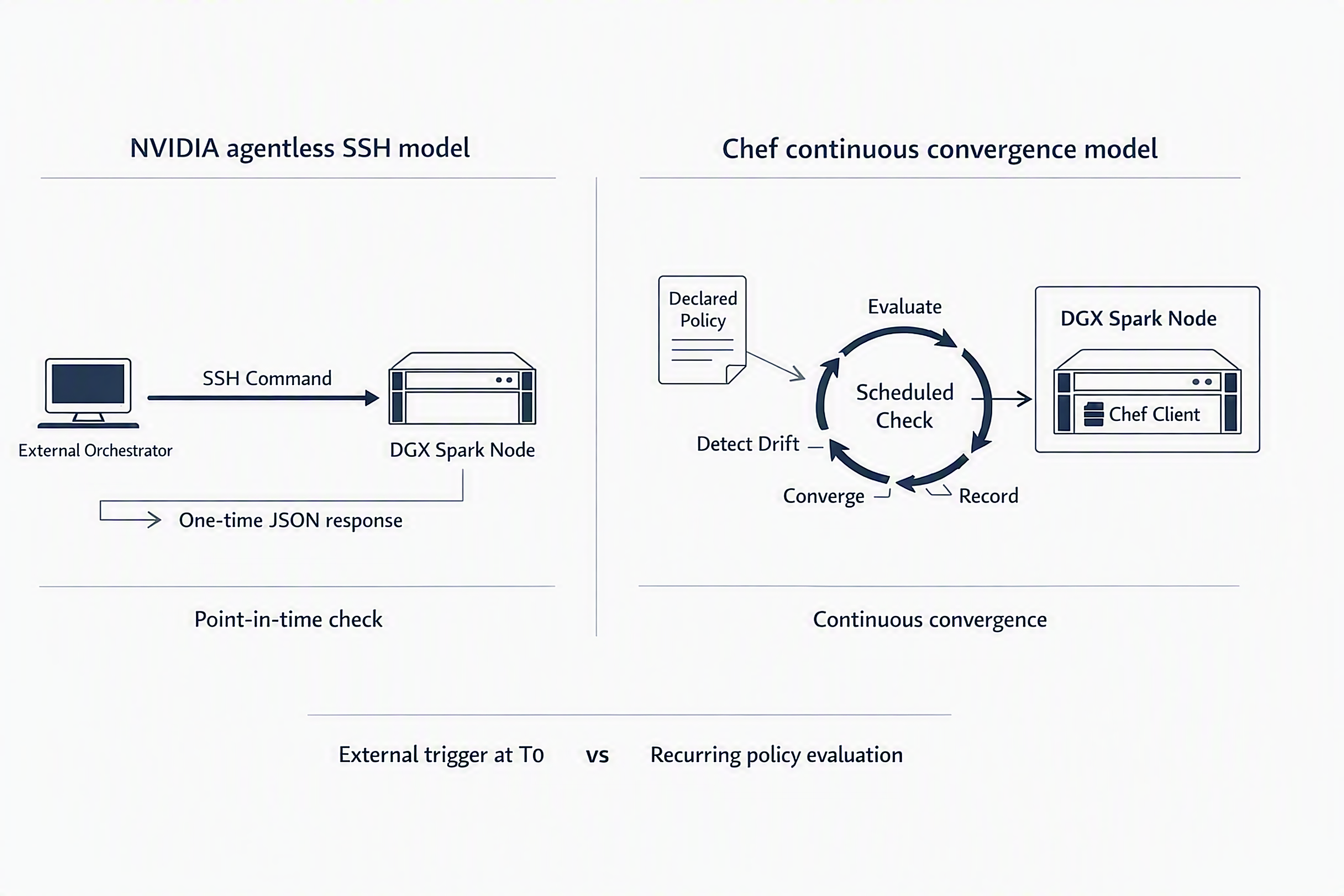
Chef 360 complements NVIDIA’s SSH-based integration pattern with centralised, policy-based management that does not require inbound SSH ports to remain open on managed nodes. Each node initiates communication, retrieves its assigned policy, and reports results through a controlled workflow. This supports a zero-trust approach while giving security and operations teams one place to define approved configurations, enforce governance and review compliance evidence across the environment.
In NVIDIA’s reference architecture, an orchestrator initiates management commands over SSH, which requires SSH connectivity to the managed systems. Chef adds a complementary, zero-trust-oriented operating model: the client on each managed node initiates outbound communication, evaluates its assigned policy on a recurring schedule and converges toward the declared state without requiring inbound SSH ports to remain open. This reduces the exposed management surface while preserving centralised control. The practical difference is persistence: an externally initiated check reports the state it observes at that moment, while scheduled convergence repeatedly detects and corrects drift, recording the result.
The Circle of Life for an AI Workstation
For a workstation or IT operations team, the lifecycle is familiar even when the hardware underneath it isn't. Here's how Chef maps onto a DGX Spark node, end to end:
| Lifecycle phase | What Chef does | Outcome |
|---|---|---|
| Provisioning | Captures inventory via Ohai, applies a baseline Policyfile, configures approved packages and settings | A known-good starting point |
| Monitoring | Collects structured node data with Ohai, validates posture with InSpec | Visibility at each assessment and evidence of the recorded state |
| Remediation | Detects drift and converges the node back to policy automatically | Fewer manual fixes, more consistent systems |
| Retirement | Executes decommission policy and records final state | Clean handoff, redeployment, or disposal |
Walking Through the Demo
1. Provisioning: one policy, one command
The following snippets illustrate the intended Policyfile, compliance and remediation flow. They use representative resource names, package names and commands to explain the design rather than provide a production-ready implementation.
A brand-new DGX Spark, fresh out of the box, gets a single Policyfile assignment instead of a manual checklist. The policy governs everything, including resource limits, approved software, an isolated account for the AI workload to run under, and what the workload is allowed to do.
# Policyfile.rb — ai_dev_workstation
name 'ai_dev_workstation'

default_source :supermarket
run_list 'dgx_spark_baseline::default'

cookbook 'dgx_spark_baseline', path: 'cookbooks/dgx_spark_baseline'

# chef-client on the node:
$ sudo chef-client
Chef Infra Client, version 18.10.17
Using Policyfile 'ai_dev_workstation' at revision
  '4cdcdfd3de33d1ada914d1fb60deb4f31d89a28c1690ba09d57784622ace465e'
Infra Phase starting
Converging 12 resources
Chef Infra Client finished, 12/12 resources updated
What used to be a per-machine checklist is now a single policy assignment. The same policy can be applied consistently as the environment scales from a single DGX Spark system to a larger managed fleet.
2. Proving it, not just claiming it: installed vs. verified
The most convincing moment in the demo isn't the automation — it's the proof. We run the same InSpec compliance check on the same machine, twice, with a Chef convergence in between.
# inspec exec dgx_spark_baseline_profile

  ×  required-ai-toolchain: AI toolchain packages installed
     ×  cuda-toolkit should be installed
     ×  ai-model-runtime should be installed
     ×  policy-agent should be running

Summary: 0 successful, 3 failures
Then Chef converges the node to the ai_dev_workstation policy ...
# inspec exec dgx_spark_baseline_profile

  ✓  required-ai-toolchain: AI toolchain packages installed
     ✓  cuda-toolkit should be installed
     ✓  ai-model-runtime should be installed
     ✓  policy-agent should be running

Summary: 3 successful, 0 failures
Same check, same machine, completely different result.
A system that proves compliance only when checked is not continuously compliant.
Installing the required components establishes the desired state; running InSpec independently verifies that the node meets the defined controls. Together, convergence and verification turn configuration into evidence.
3. Catching drift: the prohibited-model scenario
AI development workstations are valuable precisely because developers can install tools, pull models and experiment quickly. That same openness creates the governance risk: freedom that accelerates discovery can also introduce unapproved software, data exposure or licensing concerns faster than a manual review process can catch them.
The scenario that resonated most with NVIDIA's engineers wasn't a missing package — it was model governance. If a developer pulls down a model or skill that IT hasn't approved, the node has drifted from policy just as surely as if a config file had been hand-edited.
# dgx_spark_baseline/recipes/model_governance.rb

approved_models = node['ai_workstation']['approved_models']

installed_models.each do |model|
  next if approved_models.include?(model.name)

  log "Unapproved model detected: #{model.name}" do
    level :warn
  end
end
On the next scheduled run, Chef detects the unapproved model and logs the finding. The policy can then quarantine, remove or flag the model according to the organisation’s approved remediation workflow. For destructive actions, teams should validate the policy in a non-production environment and require the appropriate authorisation before fleet-wide enforcement.
4. Every change is logged automatically
Each completed Chef run records its Policyfile revision, the resources it evaluated or changed and a timestamp in the platform. These records provide useful operational evidence when security or compliance teams investigate an event or respond to an auditor. The audit trail is generated as part of routine policy execution rather than assembled manually after the fact.
In this demo environment, the fleet is configured to converge every 30 minutes. That schedule limits the window between a configuration drifting from policy and Chef attempting to correct it; the interval can be adjusted to match each organisation’s operational and risk requirements.
Why This Matters Beyond DGX Spark
DGX Spark is an early example of a pattern likely to repeat as desktop AI systems enter enterprise environments. The hardware will change, but the operating lifecycle will not: provision, monitor, remediate and retire. Every fleet will still need to prove its state rather than assume it.
For enterprises building fleets of AI-capable endpoints, the differentiator is not a one-time command that configures a system and reports what it found. It is a policy-driven operating model that repeatedly evaluates every device, corrects drift and produces evidence of the resulting state. A command can tell you what was true at T0; continuous convergence is how you keep the next hour, day and month from becoming an unknown.
Try It Yourself
Explore the DGX Spark management solution, then use the demo flow in this article to test a baseline policy, verify it independently and observe how the node responds to drift. Start with one representative system, validate the remediation behaviour, and expand only when the policy produces the evidence your security and operations teams require.

