
Did you know that on average, a large organization uses 7+ tools across the DevOps lifecycle?
Teams solved local problems quickly, adopted point solutions and moved on.
Over time, those well-intentioned decisions created a fragmented automation landscape: different tools for configuration, compliance, remediation, patching and orchestration. Each, operating in silos.
Despite this heavy investment, only one in five organizations believes they have the right tools in place to scale DevOps effectively. From being a mere deterrent, tool sprawl has moved up the corridors of infamy, becoming a direct barrier to efficiency, governance and ROI.
The Cost of Automation Sprawl
At first glance, more tools can feel like more capability. In practice, the opposite is often true. Disconnected automation toolchains introduce complexity at every layer:
• Longer time-to-value as teams spend time integrating and maintaining tooling instead of delivering outcomes
Why Standardized Outcomes Matter More Than Standardized Tools
The disconnect between automation adoption and automation effectiveness is driving a shift in enterprise strategy. Enterprises need confidence that:
• Remediation is repeatable, auditable and policy-driven
Standardized outcomes allow organizations to move faster because guardrails are in place. The challenge is achieving this without disrupting existing investments or workflows. The question is no longer which tool to add next, but how to unify automation into a single, scalable platform.
Unifying automation is no longer just an efficiency play. It’s a strategic imperative for organizations that want predictable, compliant and scalable operations.
This is where the Progress Chef 360 platform changes the conversation.
Chef 360 provides a consolidated automation platform that brings infrastructure automation, continuous compliance, node management, and orchestration together under a single control plane. It applies a consistent workflow model across agent-based and agentless execution, embeds policy enforcement directly into automation workflows and provides centralized visibility across hybrid and regulated environments.
Let’s see how.
The Chef 360 Platform Approach to Unified Automation
Chef 360 takes a fundamentally different approach from point automation tools. Instead of solving one problem in isolation, it provides a unified automation platform that brings configuration management, compliance, remediation, and orchestration together under a single operational model.
This platform-led approach allows enterprises to:
- Reduce reliance on disconnected tools
- Centralize automation logic without centralizing ownership
- Standardize outcomes while preserving team autonomy
Chef 360 becomes the control plane for automation, aligning people, processes and systems around consistent, governed execution.
Reducing Tools Sprawl Without Ripping and Replacing
One of the biggest barriers to unification is fear of disruption. Enterprises often worry that reducing tool sprawl means abandoning years of investment.
Rather than requiring a wholesale replacement strategy, the platform integrates with existing automation investments, including those of Ansible or Puppet, bringing them into a unified orchestration and governance model. This means:
- Existing tools can continue to be used where they add value
- Automation workflows can be coordinated and standardized
- Policies can be enforced consistently across heterogeneous environments
Over time, this naturally reduces tool sprawl through consolidation driven by clarity and outcomes.
From Automation Activities to Automation Outcomes
Many organizations automate tasks. Far fewer automate outcomes. The Chef 360 platform shifts the focus by connecting:
- Continuous compliance: proactively identifying drift
- Policy-driven remediation: correcting issues automatically and safely
- Orchestrated workflows: ensuring fixes are executed in the right order, at the right time
This integrated approach ensures that automation doesn’t stop at detection or configuration; it extends through resolution and validation.
The result is not just automation at scale, but automation with accountability.
Built for Enterprise-Ready Operations
Unifying automation is especially challenging in regulated and restricted environments, where security, governance, and control are non‑negotiable.
The Chef 360 platform is designed to operate within these constraints:
- Runs inside existing infrastructure and Kubernetes environments
- Aligns with enterprise security, networking, and governance policies
- Provides audit-ready visibility and traceability across automation workflows
This enables standardization of outcomes without compromising regulatory or organizational requirements.
Why Chef 360 Has the Upper Hand Over Point Automation Tools
While tools like Puppet, SaltStack, and Ansible help automate specific tasks, they are typically deployed as point solutions, leaving enterprises to stitch together configuration, compliance, remediation, and orchestration across disconnected systems.
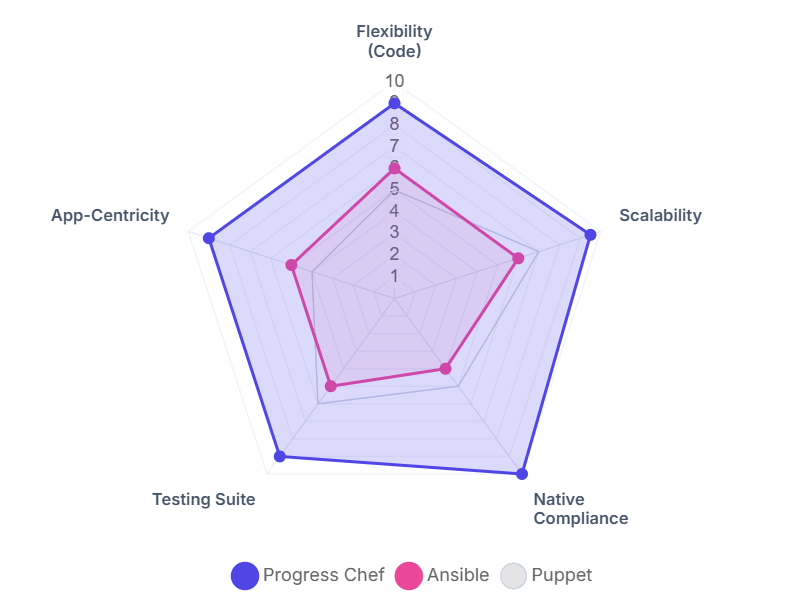
Chef 360 takes a broader platform approach by acting as a unified control plane across all of them. Rather than forcing teams into a single automation engine. Chef 360 brings heterogeneous workflows into one SaaS-first (also available for on-premises) platform with shared rollout governance, approval gates, compliance evidence, rollback logic and a single audit trail. Where Ansible, Puppet, and Salt typically require separate tooling paths, glue code and post-change evidence reconstruction, the Chef 360 platform model is designed to consolidate fragmented automation estates into one governed operating layer for change, enabling enterprises to orchestrate agent-based and agentless workflows with consistent visibility, policy enforcement, and provable outcomes at scale.
When we look at the field, the difference between a "point solution" and a "unified platform" becomes clear. Chef 360 isn't just about managing nodes; it's about managing the entire risk and operational profile of your infrastructure.
| Feature | Progress Chef 360 | Ansible (Red Hat) | Puppet (Perforce) |
|---|---|---|---|
| Philosophy | Unified Platform | Point Solution (Tasks) | Point Solution (Config) |
| Scale | Autonomous Pull (100k+ nodes) | Push-based (SSH Overhead) | Catalog-based (Master Load) |
| Compliance | Native: Detect and Correct Loop | Stitched/External Scripts | Separate Module |
| Flexibility | YAML and Policy as Code | YAML-only (Complex Logic issues) | Proprietary DSL |
By connecting continuous compliance with automated remediation and orchestrated workflows and by integrating with existing automation investments rather than forcing replacement, the Chef 360 platform reduces tool sprawl while ensuring automation is not just executed, but governed, repeatable and auditable at scale.
In its latest release, Chef 360 now makes resilience a first-class platform capability with built-in disaster recovery, enabling teams to back up and recover confidently through a guided Admin Console experience. Bring Your Own Kubernetes extends that control further, allowing enterprises to run Chef 360 within their own Kubernetes environments while aligning with existing security, networking and operational standards.
Conclusion
For organizations struggling with tool sprawl, fragmented automation and inconsistent operational outcomes, the answer isn’t another point solution. It’s a platform that brings order, visibility and consistency to automation at scale.
By unifying automation through Chef 360, enterprises can:
- Simplify operations without sacrificing flexibility
- Reduce risk through consistent, policy-driven execution
- Accelerate delivery by focusing teams on outcomes, not tooling
Automation shouldn’t be a collection of disconnected efforts. It should be a coordinated system that delivers predictable, repeatable results, everywhere it runs.
The Chef 360 platform makes that possible.
To know more, compare Chef 360 platform capabilities with Ansible and Puppet.


